11
11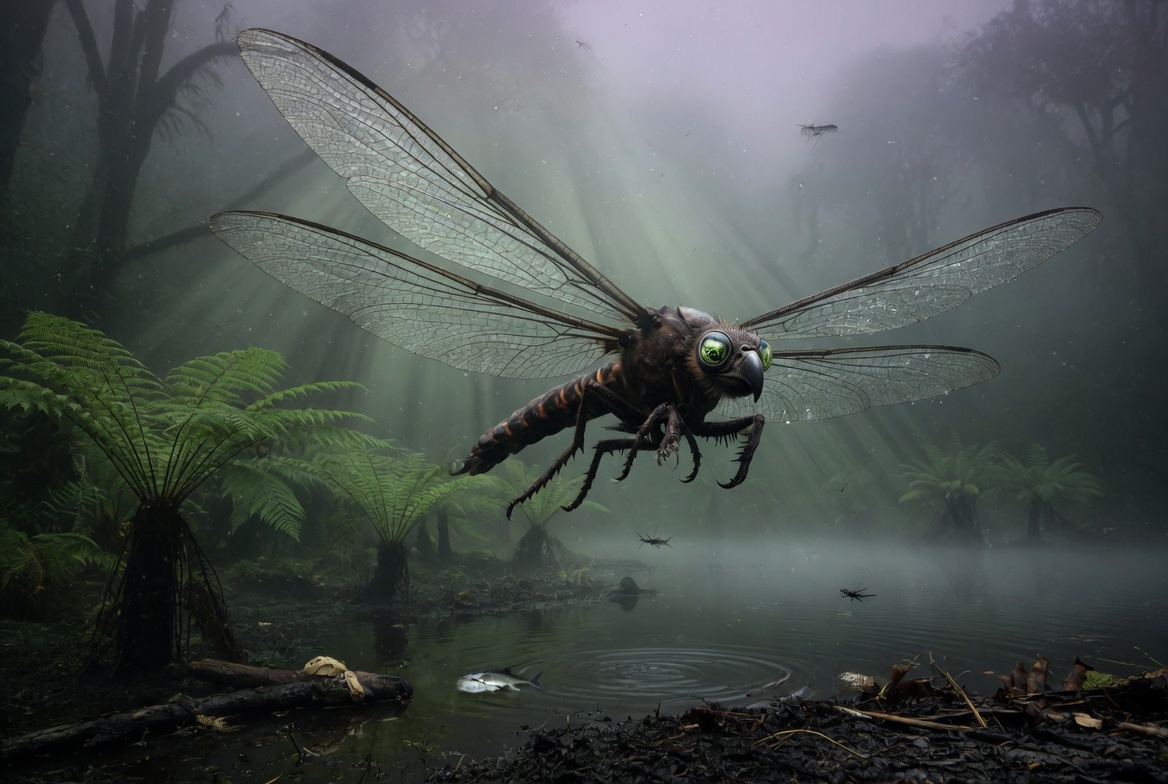
A shadow passes over a quiet Carboniferous wetland.
At first glance, the animal looks completely recognizable. Four transparent wings catch the filtered sunlight. A narrow, elongated body maneuvers effortlessly above dark, standing water, and large compound eyes scan the dense vegetation below. Then, the scale becomes clear.
This is not a modern dragonfly hovering above a pond. The wingspan approaches the width of a human arm.
More than 300 million years ago, dragonfly-like insects called griffinflies moved through atmospheric conditions unlike anything alive today. Among the most famous was Meganeura, a lasting symbol of the Carboniferous world and its oversized arthropods.
The truth is more compelling: researchers are analyzing this ancient flyer to understand how a planet’s shifting atmosphere can completely rewrite the limits of biological size.
Meganeura is frequently described as a giant dragonfly, a shorthand that works perfectly for visual recognition. However, it did not belong to modern dragonfly lineages; it was a member of an extinct sister group known as the Meganisoptera, or griffinflies.
Fossils preserve fragments—delicate, veined wing impressions compressed into ironstone or coal shale layers. Paleontologists compare these structural remains with living insects, map ancient environmental data, and reconstruct a lost aerial ecosystem.
The connection between elevated atmospheric oxygen and arthropod gigantism is one of the most famous hypotheses in paleontology, but treating it as a simple, one-sentence answer flattens the real science.
While a highly oxygenated atmosphere opened the physical door for Meganeura to grow, a complex web of ecological factors allowed it to thrive:
Giant insects perform exceptionally well on social media because the visual is immediate: a dragonfly the size of a hawk navigating a fantasy nightmare world where every bug is a monster.
However, the actual fossil record reveals a much more interesting natural experiment. Meganeura and its giant relatives were the exceptions, not the rule. The Carboniferous ecosystem was not a chaotic monster movie; it was a balanced, fully functioning biosphere where the vast majority of beetles, roaches, and crawling insects remained perfectly ordinary in size.
The terror of Meganeura does not come from fantasy upgrades, random spikes, or impossible aggression. It comes from deep familiarity scaled far beyond modern comfort.
To appreciate Meganeura without slipping into exaggeration, the boundary between physical evidence and scientific theory must remain clear.
The Confirmed Facts
The Theory
Scientists still actively debate the exact percentage of influence that oxygen held compared to temperature, flight mechanics, and the lack of vertebrate predators. The precise interplay of these environmental variables remains an active biomechanical equation rather than a settled fact.
A fake mystery treats uncertainty as permission to invent. A science mystery treats uncertainty as an invitation to look more closely at how the physics of our planet shapes the boundary of life.
The most important takeaway is simple: Meganeura did not need to be fictionalized. Dragonfly-like insects with enormous wingspans genuinely moved through Carboniferous skies.
The fossil evidence confirms a body plan strange enough to stop people mid-scroll. The scientific interpretation adds the deeper layer: why that body may have evolved, how it maneuvered through a vanished atmosphere, and which parts of its ecology remain unresolved.
This is real natural history.
Not supernatural horror.
Not fake proof.
Just a real piece of Earth’s past that feels completely impossible.