11
11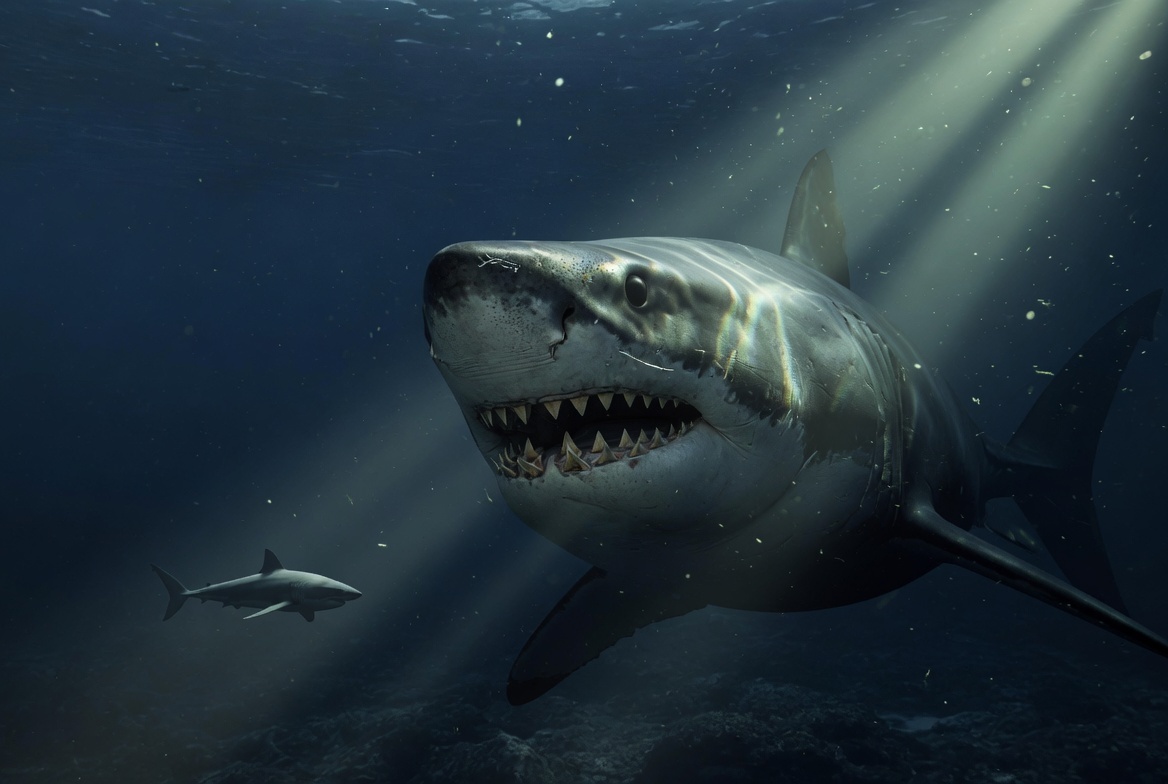
Long before humans crossed oceans, before ships, submarines, or sonar, Earth’s seas belonged to something almost impossible to imagine:
That animal was Otodus megalodon, better known as megalodon.
It was not a myth. It was not a movie monster. It was a real prehistoric shark, known mostly from fossil teeth and vertebrae. But because shark skeletons are made mostly of cartilage, they rarely fossilize completely. That means scientists are still reconstructing its true body shape, hunting style, and maximum size from limited evidence.
And that is exactly what makes megalodon so fascinating.
We know it existed.
We know it was enormous.
But the full picture is still partly hidden in deep time.
Megalodon lived millions of years ago, during a time when the oceans were warmer and full of large marine mammals. It was one of the largest predatory fish ever known.
Its fossil teeth have been found in many parts of the world, suggesting it had a wide global range. These teeth are thick, serrated, and built for cutting through flesh and bone. They are not the teeth of a small fish-eater—they are the tools of an apex predator.
Most reconstructions suggest megalodon was far larger than a modern great white shark. Some estimates place large individuals around 50 to 60 feet long, though exact size is still debated because scientists do not have a complete skeleton.
That uncertainty matters.
A 50-foot shark is already terrifying.
A 60-foot shark changes the entire food chain.
Megalodon likely fed on large marine animals, including whales and other marine mammals. Bite marks found on fossil bones support the idea that it attacked large prey.
This was not a creature surviving on tiny fish.
Its size would have required huge amounts of energy. A predator that large needs big meals, and ancient oceans had the right prey base for a while. Whale evolution may have helped fuel megalodon’s rise, giving it access to rich, calorie-heavy targets.
But that same dependence may have made it vulnerable. When ocean conditions changed, prey changed too.
And a giant predator can become a victim of its own success.
This is where the story gets colder.
Megalodon went extinct millions of years ago. Scientists generally connect its disappearance to a combination of factors:
No single explanation fully solves the mystery. It was probably not one dramatic event, but rather a slow squeeze:
Less suitable habitat.
Less accessible prey.
More competition.
And for a predator that needed enormous meals, that was enough.
This is the part where internet legend takes over.
The idea that megalodon still hides somewhere in the deep ocean is popular because the ocean is still mysterious. Much of the deep sea remains unexplored, and people love the idea that a giant prehistoric predator could survive unseen.
But there is no confirmed evidence that megalodon is alive today:
Scientifically, megalodon is considered extinct. The deep ocean is mysterious, yes, but a huge warm-water apex predator would still leave traces, especially if it needed large prey populations to survive.
The mystery is not whether it is secretly alive.
The real mystery is how something so dominant could vanish completely.
Megalodon does not need fake survival theories to be terrifying. The confirmed animal was already more frightening than most myths:
Its extinction is a reminder that even the most powerful animals are not immune to a changing planet. The ocean once had room for a shark this huge. Then the rules changed, and the biggest predator disappeared.
Not in one dramatic final battle.
But quietly, through time.
That may be the eeriest part of all.
References: