11
11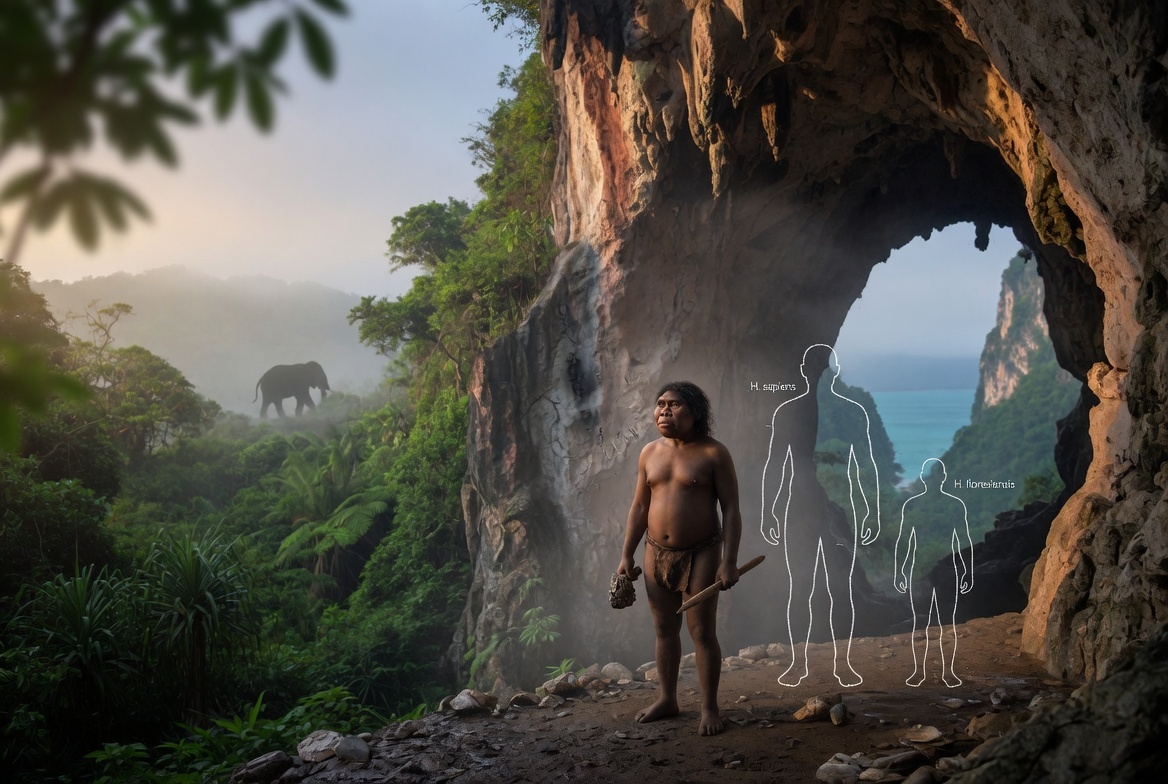
In 2003, researchers excavating Liang Bua cave on the Indonesian island of Flores uncovered the partial skeleton of a tiny adult human relative.
The individual was not a child; the bones belonged to an adult female who stood only a little over one meter tall. Her brain was estimated at around 400 cubic centimeters, comparable in size with those of chimpanzees and the smallest australopithecines.
Yet the skeleton appeared in relatively recent geological layers.
The discovery forced scientists to confront a surprising possibility: a small-bodied human lineage with a small brain had survived on an Indonesian island until tens of thousands of years ago.
Researchers named the species Homo floresiensis. The public gave it a faster nickname: the “hobbit.”
That nickname made the fossils famous, but the real story is deeper than a pop-culture comparison. Homo floresiensis challenged assumptions about body size, brain size, island evolution, and the routes ancient humans used to move across Southeast Asia.
The best-known skeleton is called LB-1. According to the Smithsonian Human Origins Program, LB-1 died as an adult around the age of 30 and stood only a little over one meter tall.
Her skeleton included an almost complete skull and parts of the legs, hands, feet, pelvis, and other bones.
The combination of features was unusual. Homo floresiensis had a small body and small brain. Some traits appeared primitive, while others reflected its own distinct evolutionary history.
Scientists did not simply classify the bones as a modern human with a medical condition. The fossils were assigned to a distinct species because the anatomy and broader evidence pointed toward a separate lineage. Since the initial discovery, researchers have recovered remains representing multiple individuals at Liang Bua.
Flores is not connected to mainland Asia by dry land. Even during periods when sea levels were lower, reaching the island required crossing water.
This creates one of the most important questions in the story: How did the ancestors of Homo floresiensis arrive?
Smithsonian material notes that stone tools found on Flores indicate early humans reached the island at least one million years ago. However, the identity of those toolmakers and their exact route remain uncertain.
Scientists do not have a confirmed answer. The mystery matters because Flores was never an easy place to reach accidentally. A human lineage appeared on the island long before modern seafaring technology.
Islands can reshape evolution. Large animals sometimes become smaller when resources are limited and large predators are absent. Conversely, small animals can sometimes become larger when ecological opportunities open.
Flores preserved dramatic examples of this phenomenon:
Homo floresiensis developed within this unusual island world. One major explanation for its size is island dwarfism. The ancestors may have descended from a larger-bodied human lineage, possibly an early Asian Homo erectus population, and gradually became smaller after long isolation.
A 2024 Nature Communications paper strengthened this interpretation.
The 2024 study examined fossils from Mata Menge, another site on Flores. These fossils are far older than the Liang Bua skeletons, dating back to around 700,000 years ago.
Among the discoveries was an adult upper-arm bone, or humerus, that was extraordinarily small. Researchers estimated that it was 9 to 16 percent shorter and thinner than the corresponding bone from the later Homo floresiensis type specimen. The paper described it as smaller than any other known adult hominin humerus from the Plio-Pleistocene fossil record.
Two small teeth also contributed to the picture. One showed similarities with early Javanese Homo erectus.
The researchers argued that the Homo floresiensis lineage most likely evolved from early Asian Homo erectus and had already developed markedly small body size by around 700,000 years ago. The “hobbit” was not a short-lived anomaly; tiny-bodied human relatives may have persisted on Flores for an immense span of time.
Fossils at Liang Bua associated with Homo floresiensis date from approximately 100,000 to 60,000 years ago. Stone tools associated with the cave layers extend to around 50,000 years ago.
That is remarkably recent in evolutionary terms. Modern humans were already spreading through parts of the world, and other human lineages also existed during overlapping periods.
Homo floresiensis became one of the last known early human species to disappear.
The extinction question remains open. Climate changes, volcanic activity, ecosystem shifts, competition, and encounters with modern humans have all entered discussion. The Smithsonian lists the possible relationship with Homo sapiens as an unresolved question. Researchers do not have a direct fossil record showing a meeting between the two species.
Yes. Stone tools have been recovered on Flores.
Tools associated with Homo floresiensis layers at Liang Bua resemble broader, simple stone-tool traditions used across long periods of human evolution.
The important point is not that the tools looked technologically advanced by modern standards. The important point is that a small-brained human relative used stone technology successfully in an island environment.
This complicates simplistic assumptions that brain volume alone determines behavior. Evolution does not move through one clean ladder; different lineages can solve survival problems in different ways.
The initial discovery generated intense debate. Some critics proposed that LB-1 could have been a modern human with a growth disorder or other medical condition.
However, scientific research continued through anatomical comparisons, advanced dating techniques, additional fossils, and discoveries at Mata Menge.
The evidence increasingly supports Homo floresiensis as a distinct ancient human species. The 700,000-year-old fossils are especially important because they show a small-bodied lineage on Flores long before the much later Liang Bua skeleton. A single unusual individual is one thing, but a deep evolutionary pattern is another.
No. Verified evidence does not show that Homo floresiensis survives today.
Local traditions and modern cryptid-style stories sometimes enter online discussion, but these claims should not be presented as scientific proof. Researchers have not found living individuals, recent DNA, confirmed modern remains, or any other evidence demonstrating survival into the present.
The real species remains fascinating without that claim. Homo floresiensis survived until surprisingly recent prehistory. That confirmed fact is already enough to change how people imagine the human family tree.
Homo floresiensis challenges a deeply rooted assumption. People often imagine human evolution as a direct, linear relationship between larger brains and more advanced behavior. The fossil record is much more complicated.
Brain size matters, but it is not the only factor shaping survival. Other crucial elements include:
Homo floresiensis survived on Flores for an extraordinary length of time, navigating an island ecosystem with limited resources and unusual animals. While researchers should be careful not to invent complex behaviors that fossils cannot prove, they should also avoid treating a small brain as evidence of a failed experiment. This lineage persisted for hundreds of thousands of years.
The geography of Flores may be the most unsettling part of the story. Water separated the island from surrounding land even during lower sea levels. Reaching Flores required a crossing.
That crossing may have been intentional, accidental, or repeated through processes we do not yet fully understand. A small founding population could have become isolated and changed over generations. Once isolation began, island pressures may have rewarded smaller bodies that required fewer calories.
The fossil record does not preserve the first arrival; it preserves the result. This gap leaves a cinematic image grounded in real science: a human lineage appearing on an island beyond a difficult sea barrier long before written history, with no surviving explanation of the journey.
Homo floresiensis is one of the strongest reminders that human evolution was never a simple march toward one modern form.
A small-bodied lineage lived on an isolated Indonesian island for hundreds of thousands of years. Its members used stone tools and survived beside unusual island animals. Their ancestors crossed water somehow, long before anyone left a written explanation.
The biggest mystery is no longer whether the “hobbit” existed. The fossils are real. The mystery is how its lineage reached Flores, changed under island conditions, and remained hidden from science until a cave excavation reopened the story.