11
11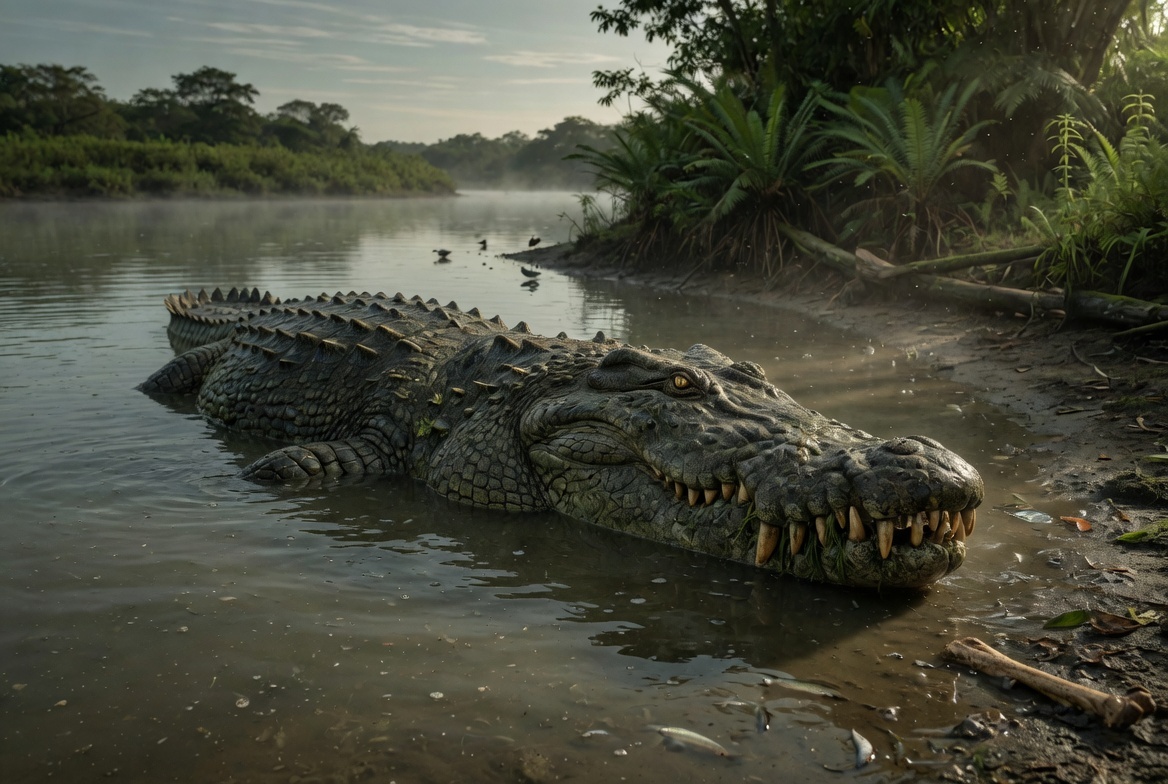
A dinosaur moves cautiously toward the water.
The landscape looks calm. Mud presses beneath its heavy feet. Insects drift effortlessly above the water’s surface. The river reflects the sky with almost no visible movement. Then, the surface erupts.
This is the scene Deinosuchus has inspired for decades: a giant crocodylian waiting at the edge of a Late Cretaceous waterway, using stillness as its primary weapon until a large animal steps within range.
The image is highly dramatic, but the physical fossils make it entirely plausible.
The truth is more compelling: Deinosuchus was not a dinosaur, but a lineage of giant alligatoroids that lived in North America roughly 82 to 73 million years ago. With the largest individuals reaching at least 10 meters (33 feet) in length, this predator single-handedly redefined the rules of the Cretaceous shoreline.
Calling Deinosuchus a “giant crocodile” is useful shorthand, but it flattens the science. It belonged to an extinct lineage of alligatoroids whose anatomy and ecological role must be studied on their own terms. Modern discoveries have pulled this apex predator out of internet mythology and placed it firmly into published research.
Fossils rarely preserve an entire life story. They preserve fragments: impressions, teeth, or deep damage marks compressed into stone. Paleontologists analyze these clues, test bite-force mechanics, and map out the ancient food webs of the Mesozoic.
The most compelling part of the Deinosuchus story is not a disputed size estimate. It is the physical bite traces left behind in the fossil record.
Researchers have documented definitive jaw damage and puncture marks attributed to Deinosuchus on fossilized turtle shells and dinosaur bones. These marks provide a direct, physical connection between the giant crocodylian and the large animals sharing its environment.
A bite mark is not a complete behavioral record. It cannot tell us exactly how an encounter began or whether a dinosaur was attacked while alive, scavenged after death, or bitten during a desperate struggle that ended in an escape.
However, the repeated pattern narrows the possibilities: Deinosuchus did not simply occupy the same landscape as dinosaurs. It actively interacted with them. This physical evidence is what turns a fossil specimen into a terrifying ecological threat.
Prehistoric storytelling often jumps too quickly from a single fragment of evidence to absolute certainty. A dinosaur bone carries damage, a giant crocodylian lived nearby, and the next illustration automatically depicts Deinosuchus dragging a massive theropod underwater in a perfectly choreographed attack.
The scene may be reasonable, but it should never be mistaken for direct security footage of a specific event.
Instead of inventing fantasy scenarios, scientists ask careful, rigorous questions: Was the animal alive when bitten? Does the spacing of the punctures perfectly match the Deinosuchus jaw template? Are similar traces found elsewhere in the same ecosystem?
The strongest conclusion is careful but still powerful: Deinosuchus was an opportunistic apex predator capable of attacking very large prey. Dinosaurs near the water were never automatically safe.
A giant predator does not always need high-speed endurance. In a wetland environment, patience is a far more efficient evolutionary tool.
The body plan of a crocodylian is built entirely around concealment. Because its eyes and nostrils sit at the very top of its skull, only a tiny fraction of the animal needs to remain above the waterline. The remaining 10 meters of muscle and armor disappear entirely into reflections, sediment, and shadow.
This positional advantage is a trap no terrestrial chase hunter could ever copy:
To understand Deinosuchus without slipping into exaggeration, the boundary between evidence and inference must remain visible.
The Confirmed Facts
The Theory
Scientists cannot mathematically calculate how often dinosaurs were hunted compared to fish or carrion, nor can they prove that every large individual utilized identical hunting strategies. The exact percentage of its diet that consisted of dinosaurs remains an educated ecological inference.
A fake mystery treats uncertainty as permission to invent. A science mystery treats uncertainty as an invitation to look more closely at the mechanics of deep time.
The most important takeaway is simple: Deinosuchus turned the water’s edge into a danger zone. The animal was enormous, its teeth were real, and the dinosaur bones carrying its bite marks are set in stone.
The fossil evidence confirms a body plan strange and terrifying enough to stop people mid-scroll. The scientific interpretation adds the deeper layer: why that body evolved, how the animal leveraged its environment, and which parts of its behavioral routine remain unresolved.
This is real natural history.
Not supernatural horror.
Not fake proof.
Just a real piece of Earth’s past that feels completely impossible.